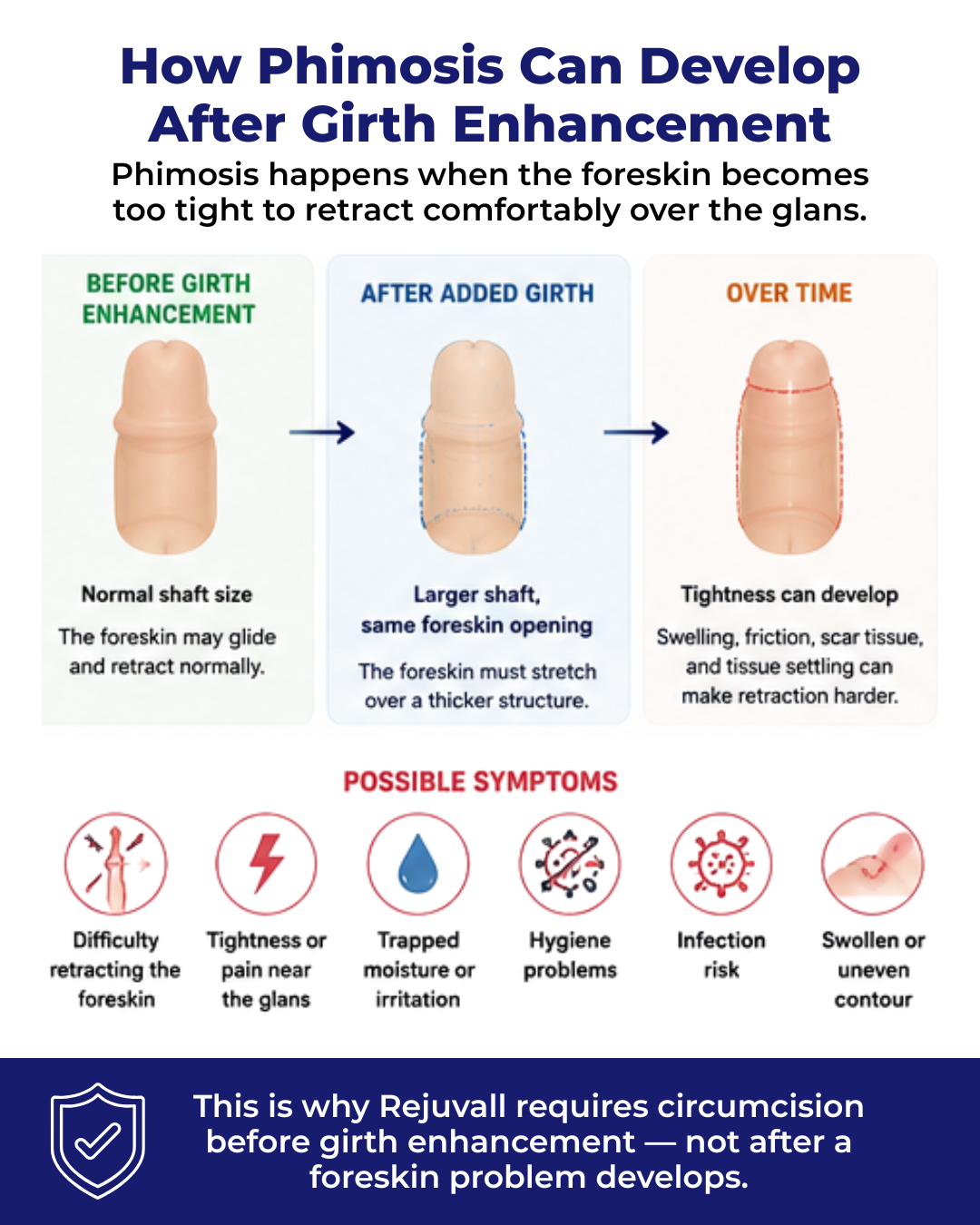
We published a new article because this topic comes up often, and we think men researching girth enhancement deserve a clearer explanation than “it depends on technique.”
Why does Rejuvall require circumcision before penile girth enhancement?
The short answer: because the foreskin problem is
not just an injection-depth problem. It is a
long-term mechanical problem.
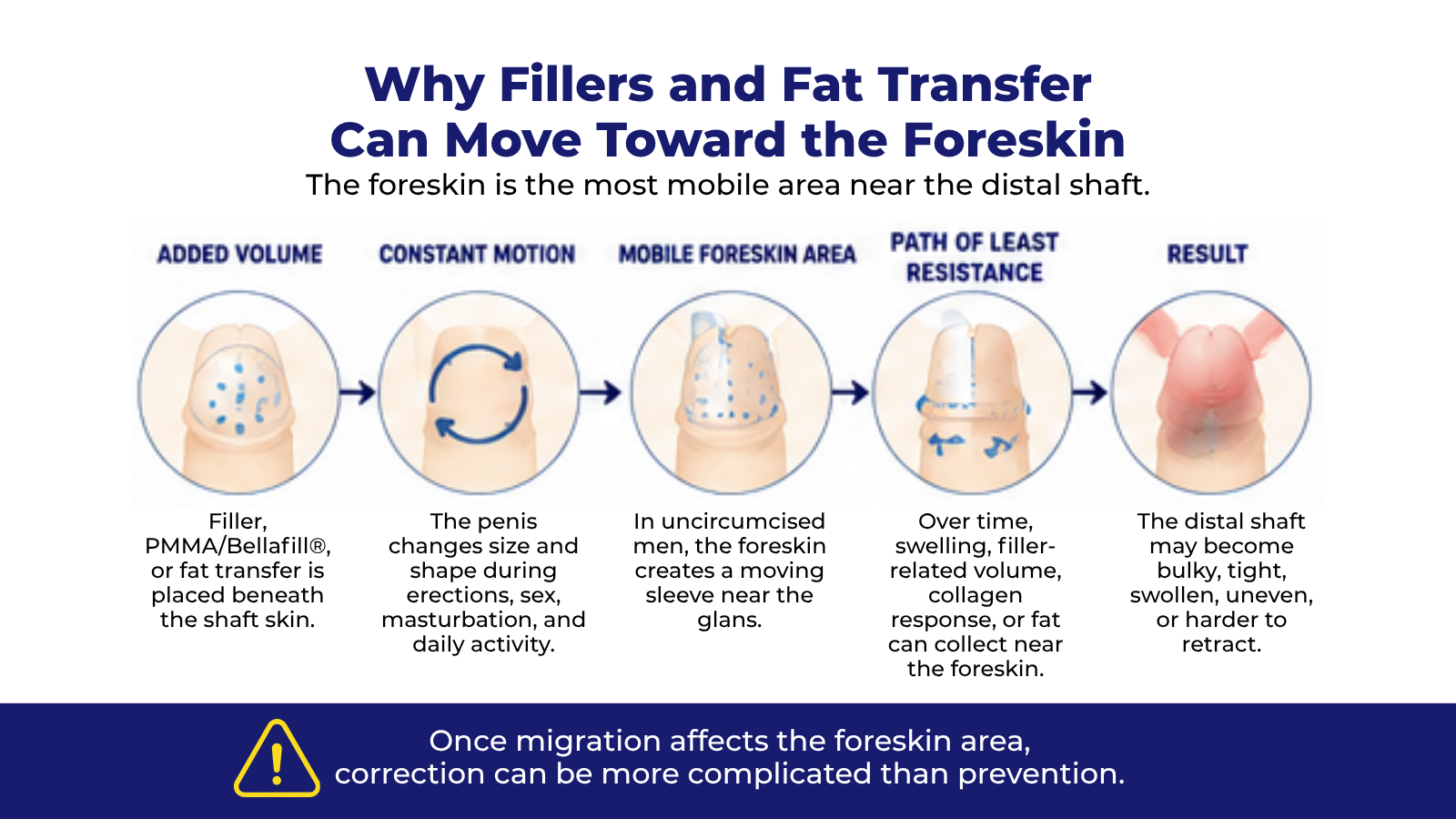
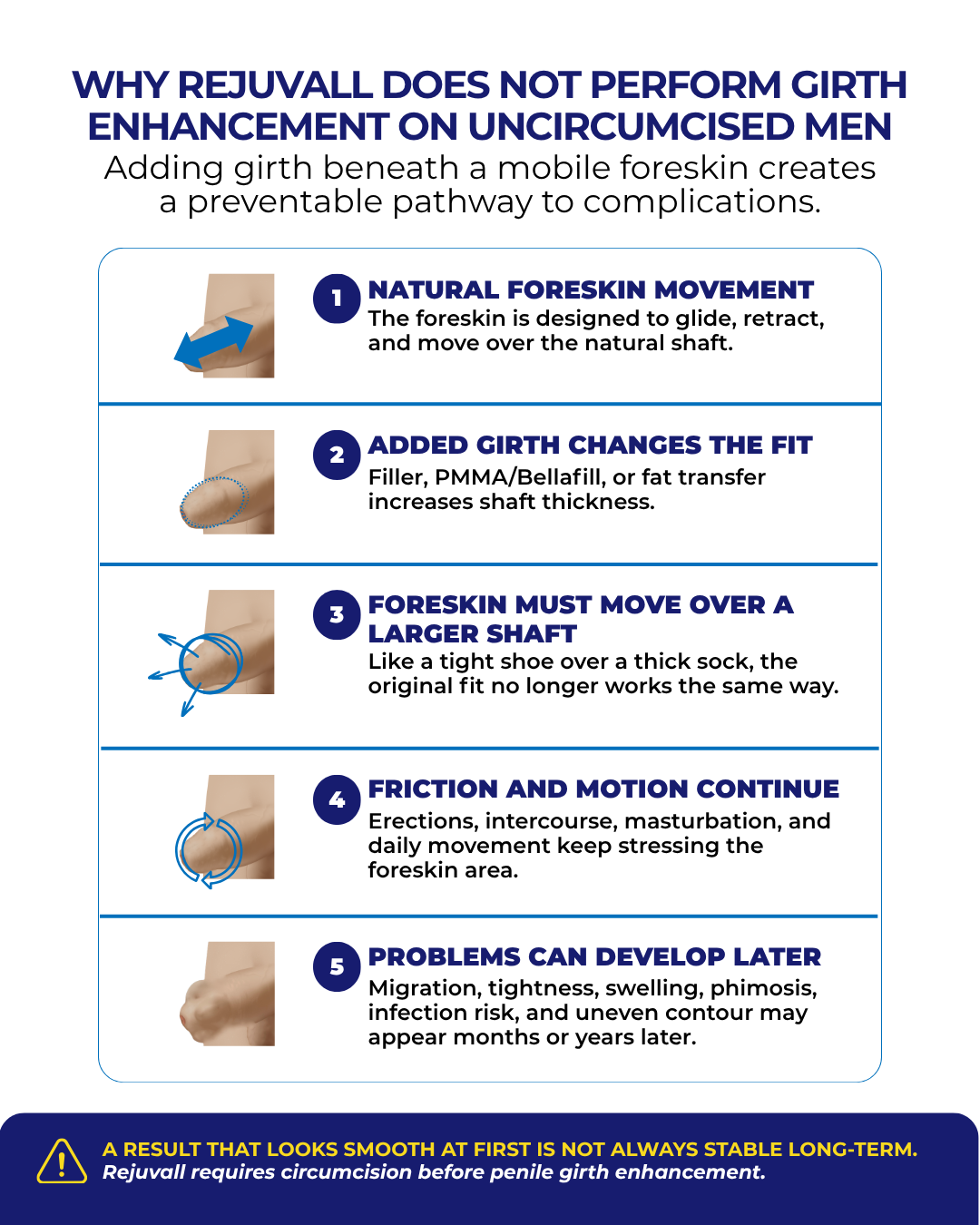
An uncircumcised penis can be completely normal and healthy. The issue begins when additional volume is added beneath the shaft skin with HA filler, PMMA/Bellafill®, other fillers, or fat transfer. Once the shaft is thicker, the foreskin is no longer moving over the same anatomy. It has to stretch, retract, glide, and return over a larger structure during erections, intercourse, masturbation, and daily movement.
That is why we disagree with the dangerous claim that “deeper placement” eliminates foreskin-related risks.
A deeper injection plane may affect where the product starts. It does not change the fact that the foreskin remains a mobile sleeve moving over an artificially enlarged shaft for months and years afterward. It does not stop friction. It does not stop swelling cycles. It does not stop collagen response. It does not stop tissue settling. It does not stop the distal shaft/foreskin area from becoming the place where tightness, swelling, or contour changes show up later.
That is the part that gets missed when people judge results from before-and-after photos.
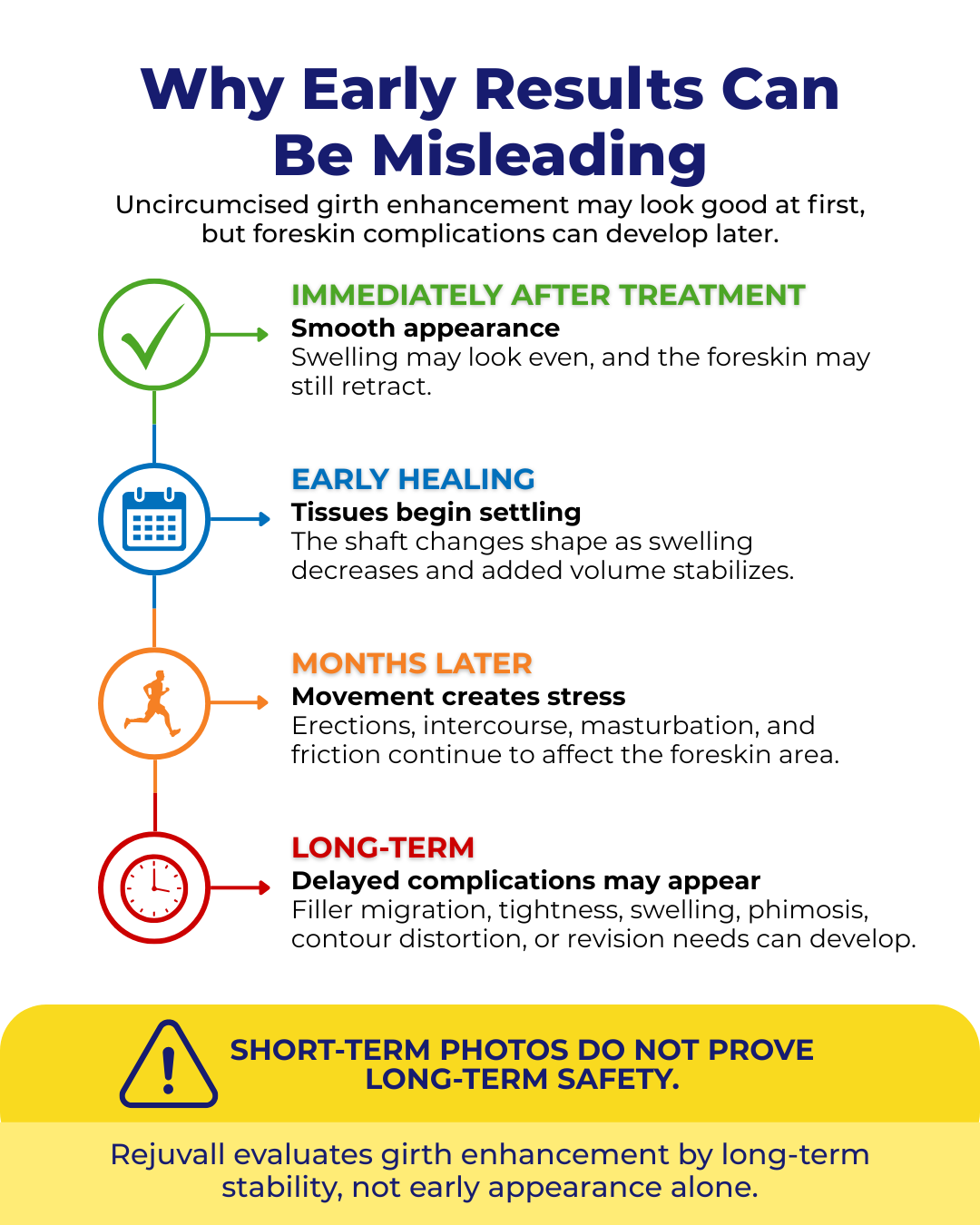
A patient can look great immediately after treatment. The filler can look smooth. The foreskin can still retract. Everyone can call it a success in the first few weeks or months.
But early appearance does not prove long-term stability.
Published medical literature on penile girth injection complications has reported issues including filler migration, phimosis, edema, infection, nodules, granuloma, deformity, lymphatic complications, and difficult revisions. One case report specifically notes that penile girth injection complications appear under-reported and can result in severe penile deformity and dysfunction.
1
At Rejuvall, we also see the practical side of this in many of our revision and repair patients. Too many men who had girth enhancement while uncircumcised were happy at first, then developed problems months or years later: tighter retraction, phimosis, distal swelling, filler or swelling collecting near the foreskin, contour distortion, hygiene problems, infection risk, or more complicated revision needs.
The simplest way to understand it is the thick sock/tight shoe problem. You might be able to force your foot into the shoe at first. It might even look fine. But the shoe was not designed for the larger size underneath. Over time it pinches, rubs, traps moisture, creates pressure, distorts shape, and causes pain.
That is why Rejuvall does not perform penile girth enhancement on uncircumcised men.
It is not a bias against foreskin. It is not a cosmetic preference. It is not something we negotiate based on how badly someone wants to stay uncircumcised.
It is a clinical safety standard.
The full article explains:
- why foreskin becomes a problem after girth enhancement
- why phimosis can develop after penile filler or PMMA
- why early results can look good but fail later
- why filler/fat can migrate toward the foreskin
- why deeper placement does not remove the long-term mechanical risk
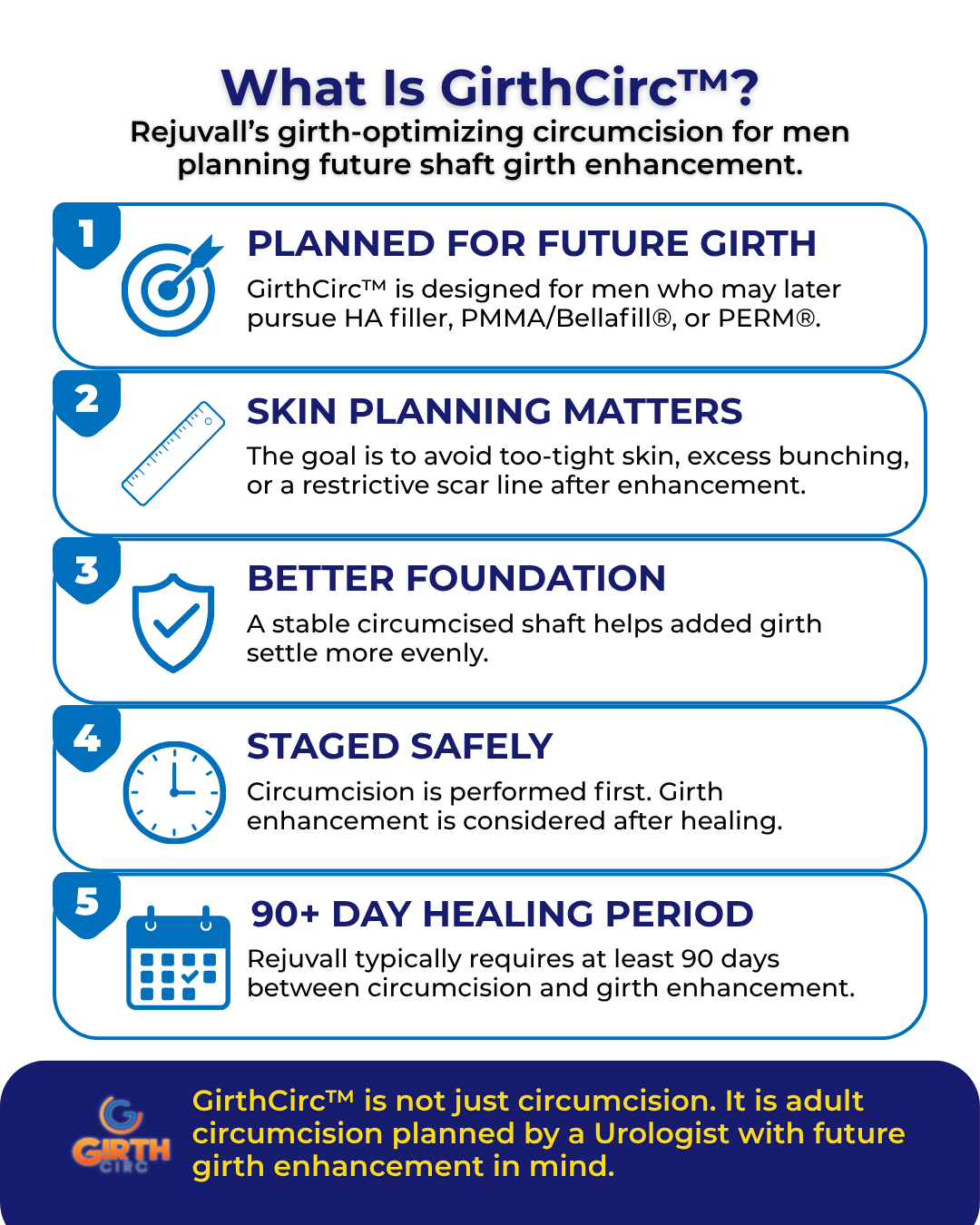
- what GirthCirc™ means
- why circumcision and girth enhancement should not be done at the same time
Full article:
www.rejuvall.com/circumcision-before-girth-enhancement/
**We know this is a controversial topic, especially for men who strongly want to remain uncircumcised. But from Rejuvall’s perspective, a result that looks good for a few months is not a success if it creates preventable foreskin complications later.
.